Overview
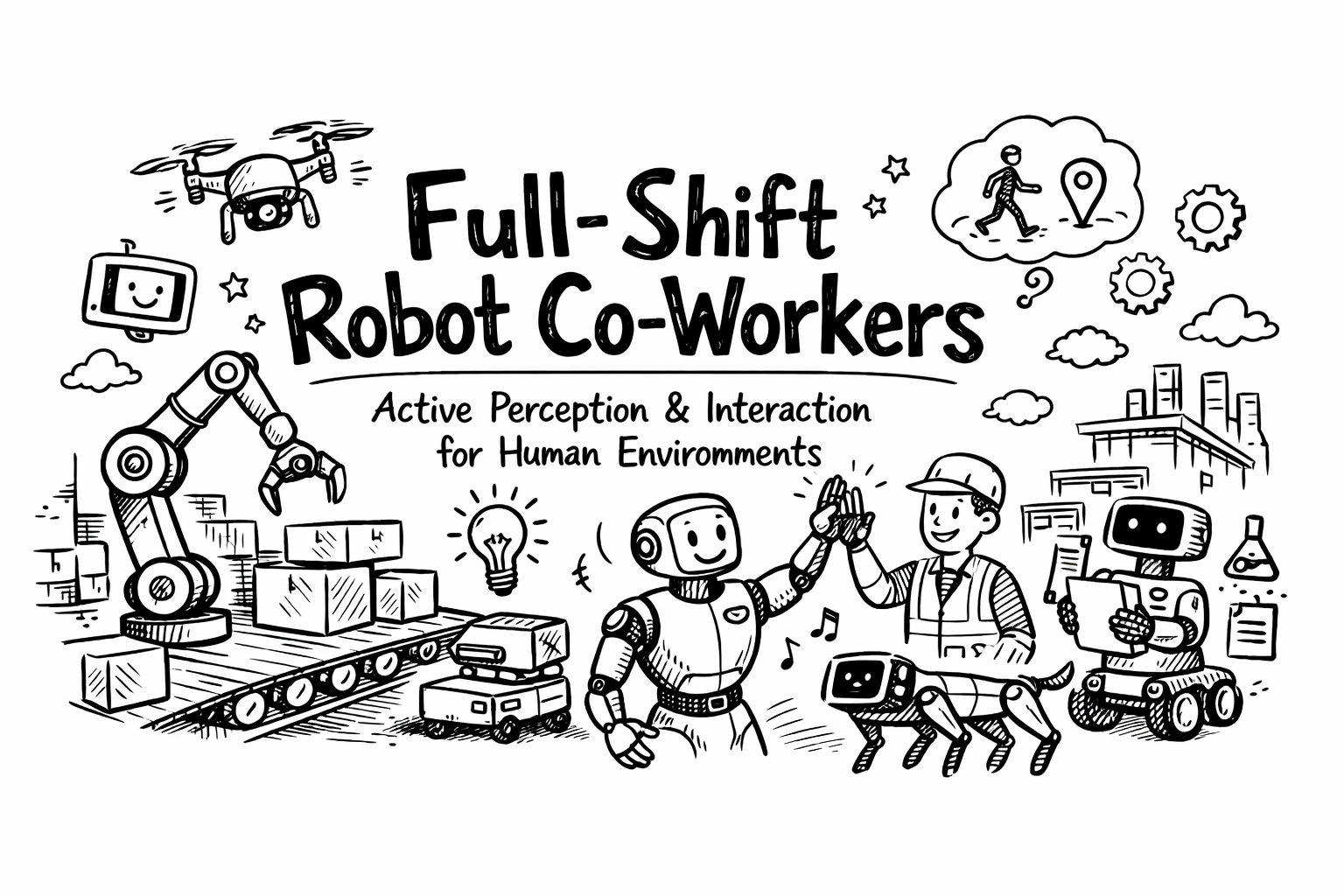
Robots are rapidly moving from fenced-off automation cells into human environments—factories, warehouses, hospitals, laboratories, and offices—where they must work safely and productively alongside people throughout an entire work shift.
This workshop explores the emerging paradigm of robots as full-shift co-workers: systems that continuously perceive, interact, and coordinate with humans in real workplaces. We bring together researchers across perception and state estimation, robot learning, planning and control, and human–robot interaction, together with practitioners deploying robots in real environments.
The goal is to identify key research questions, deployment challenges, evaluation principles, and future community directions for long-horizon robot autonomy in human-centered settings.
Call for Contributions
We invite poster submissions and short position-style contributions related to active perception, interaction-aware autonomy, long-horizon deployment, human behavior understanding, evaluation, reliability, and real-world robot operation in human environments.
- Poster submissions on ongoing or recently completed research
- Early-stage ideas and open problem statements
- Negative results, deployment lessons, and failure cases
- Cross-disciplinary perspectives from academia and industry
Call for Junior Voice
We warmly invite students, postdoctoral researchers, and early-career researchers to submit for the Junior Voice session of the workshop.
This session is designed to give junior researchers a visible platform to share emerging ideas, open questions, early-stage results, and provocative perspectives related to the workshop theme. Selected participants will be invited to give a short spotlight talk during the workshop.
We especially welcome submissions that present bold research directions, deployment-grounded observations, failure cases, or questions that can spark discussion across perception, interaction, autonomy, and human-centered robotics.
- Who can submit: students, postdocs, and early-career researchers
- Format: short abstract / position-style submission
- Selected submissions will be invited for a junior spotlight talk
- We welcome early-stage ideas, open problems, and failure cases